New State Report Reveals Damaging Effects of Potential Medicaid Cuts, Michigan’s Health Centers Would be Impacted Statewide

The Michigan Department of Health and Human Services (MDHHS) today released a new report detailing the severe impact of proposed Medicaid cuts on health outcomes across the state — a development the Michigan Primary Care Association (MPCA) warns is putting vulnerable communities at even greater risk.

MPCA is the voice of 48 member health centers that provide healthcare through over 400 locations across the state and serve one in every 15 Michigan residents. Michigan’s health centers- sometimes called Federally Qualified Health Centers, Tribal Health Centers, or Urban Indian Organizations- are community-based health organizations that deliver comprehensive primary care and other medical services, dental care, behavioral health care, substance use care, vision care, and more for patients of all ages in rural, urban, and tribal communities across the state of Michigan. Health centers operate as mission-driven, non-profit healthcare providers serving areas and populations that experience recognized challenges accessing healthcare or having sufficient healthcare providers in their area.

On a statewide basis, patients who get their health insurance through Medicaid make up 51% of all Michigan health center patients. Health centers’ patient populations in Bay, Berrien, Calhoun, Cass, Genesee, Grand Traverse, Ingham, Jackson, Kent, Macomb, Monroe, Muskegon, Kalamazoo, Oakland, Saginaw, and Wayne counties could be particularly impacted by proposed changes to the Medicaid program. Health centers serve more adult Medicaid patients in those areas, and many potential Medicaid changes focus on adults.

Proposed changes to the Medicaid program could also negatively impact the stability of health center services. Health centers, which already operate on thin margins, now face even more difficult decisions about staffing, services, and facility operations. Without urgent action to restore and strengthen Medicaid coverage, MPCA warns that more clinics could be forced to scale back critical programs or even close their doors.

This would lead to worse health outcomes throughout the state, including:

  • A measurable increase in emergency room visits for preventable conditions
  • Decreased access to prenatal and maternal care in underserved areas
  • Higher rates of untreated chronic illnesses, particularly diabetes and hypertension
  • Financial instability for primary care providers serving low-income populations

“Our health centers are safety nets for their communities,” said MPCA CEO, Phillip Bergquist, “We need to protect Medicaid from cuts not only to keep Michiganders healthy but also to safeguard public health.”

Most of the resources that health centers have to serve their communities come from being reimbursed for the patient services they deliver, and statewide Medicaid makes up 63% of patient services revenue in health centers annually. Losing a meaningful portion of Medicaid revenue could jeopardize the sustainability of some health center services and locations for everyone, not only people who get their health insurance through Medicaid.

If enacted, adult work requirements could result in 52,000 Michigan health center patients who get their health insurance through Medicaid losing coverage and health centers seeing a reduction in revenue of around $38.3 million annually. For comparison, that revenue loss would be equivalent to losing 30% of the federal health center program funding Michigan health centers receive annually, endangering the availability of essential care for tens of thousands of people.

MPCA calls on lawmakers to protect Medicaid from cuts, which would have dire consequences for communities throughout Michigan.

For a copy of the MDHHS report or to arrange interviews with health center leaders impacted by the cuts, please contact Luke LaBenne at [email protected] or 517.827.0883.

2025 HIT Conference Call for Presenters

The Michigan Primary Care Association (MPCA) is currently planning our 2025 HIT Conference. The conference will be held in-person July 10-11, 2025, at the Henry Center in East Lansing and will focus on health information tools and technologies that enhance the patient and provider experience, support UDS modernization, drive virtual care, and advance data privacy and security. The target audiences for this conference include:

  • Clinicians (MD, DO, NP, PA, DDS, PharmD)
  • Clinical Leadership (CMOs, Clinic Directors)
  • Quality Improvement and Information Technology Staff
  • Clinical and Non-clinical Support Staff (Care Managers, Medical Assistants, CHWs, Nurses, Behavioral Health Providers, Dental Assistants, etc.)

Proposals are solicited for 60–90-minute presentations that are interactive, creative, dynamic, and showcase best practices around population health tools and technologies that include the people and processes needed for success. Presentations should provide attendees with educational value and refrain from promoting a specific business, product, or service. We are seeking presenters equipped to lead sessions that demonstrate excellence in utilizing the following tools to enable success in achieving value-based contracting goals:

  • Population Health
  • Patient Outreach and Engagement Platforms
  • Virtual Care (ie. RPM, telehealth, genAI, other digital health tools)
  • Value-Based Care
  • HIT Privacy and Security (cybersecurity)
  • EHR/EDR Optimization (including UDS+)
  • Interoperability (HIE, CIE, SDOH data integration)

Interested parties should complete the linked form by Friday, April 11, 2025. 

Notifications will be sent to selected presenters by Wednesday, April 30, 2025.

MPCA’s March 2025 Newsletter is out now!

MPCA’s March 2025 Newsletter is out now! In this issue, we share an important advocacy alert about protecting Medicaid and highlight opportunities to host nurse interns and free wireless audits. We recognize National Kidney Month and highlight learning opportunities for our members. Plus, we share info about our Endorsed Business Partner, Integrity Cost Consulting, and shine our Sponsor Spotlight on MPCA Annual Conference Silver Sponsor, Health Choice Network. Read the full newsletter here.

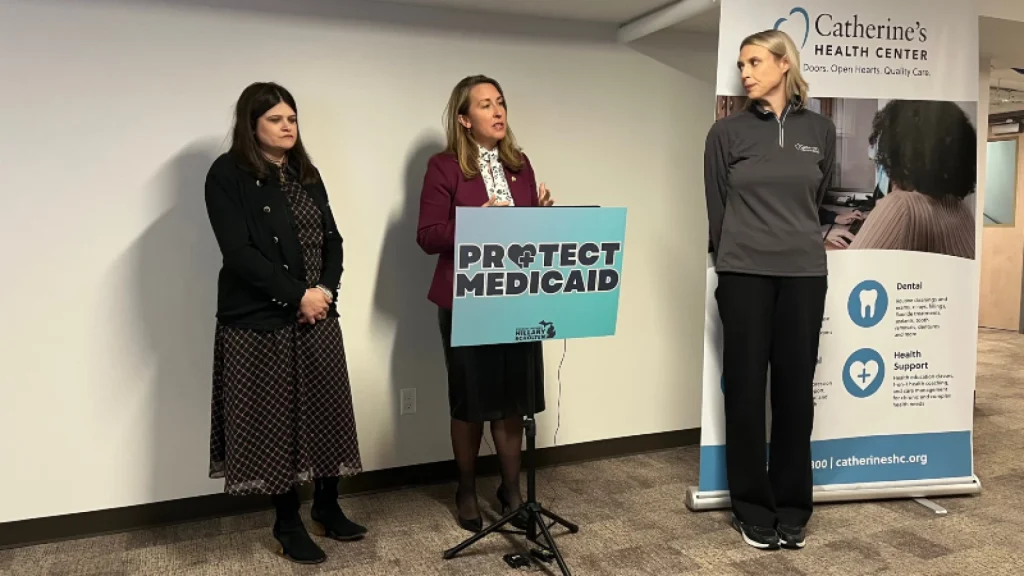
Michigan Lawmakers hold Press Conference at Catherine’s Health Center to Protect Medicaid

Photo by David Limbaugh

Two Democratic U.S. lawmakers, Rep. Hillary Scholten from Michigan’s 3rd Congressional District and Rep. Haley Stevens from Michigan’s 11th Congressional District held a press conference at Catherine’s Health Center last week to warn of the “catastrophic” consequences of the proposed cuts to Medicaid. MPCA staff was in attendance and the event was widely covered by the media.

“If these cuts go through, Michigan would be forced to make impossible choices: cutting coverage for postpartum moms, people with disabilities, seniors in nursing homes and even children with special healthcare needs,” U.S. Rep. Hillary Scholten, D-Grand Rapids, told reporters Wednesday. “The consequences would be catastrophic.”

“We are ringing the alarm bell because Republicans have proposed a budget which includes huge cuts to Medicaid and we are not going to stand by and let that happen,” Stevens said. “We must expand these services, not cut them. Seeing the work Catherine’s Health Center does here in West Michigan to ensure everyone in our community gets care, no matter their income, was profound.”

Read the full articles here:

Democratic representative from Grand Rapids warns against Medicaid cuts

Dems warn of ‘catastrophic’ consequences in Michigan if Medicaid funding is cut

Michigan Congresswomen Scholten and Stevens speak out against proposed Medicaid cuts

‘Medicaid is a lifeline’: U.S. lawmakers voice concerns over possible Medicaid cuts

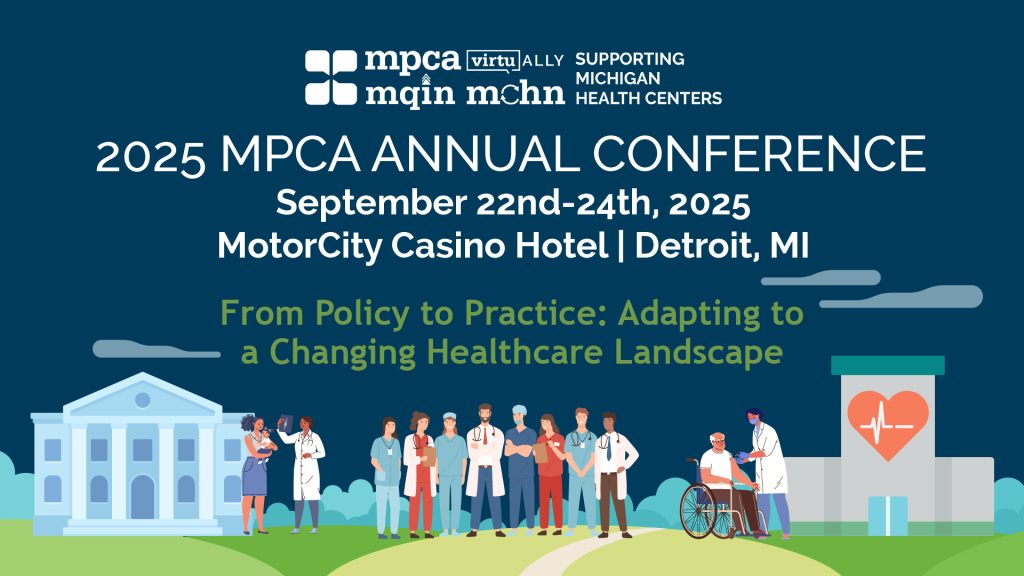
2025 MPCA Annual Conference Call for Presenters

MPCA’s 2025 Annual Conference, From Policy to Practice: Adapting to a Changing Healthcare Landscape will be held at the Motor City Casino in Detroit, MI. This conference is attended by approximately 300 attendees including CEOs, operational, financial, clinical, and dental leadership, board members, and health center clinicians.

This year’s conference will be held September 22-24.

The conference will have five main focus areas including:

  • Value-Based Care Delivery: Value-based care delivery improves health outcomes, reduces disparities, supports health center sustainability, decreases the total cost of care, and improves the experience of patients and team members. High-quality, team-based, integrated, and innovative services are essential to the success of value-based care delivery.
  • Health Information Technology & Data: Health information technology and data will be leveraged to improve care quality and efficiency, support positive and engaging care delivery experiences for patients and team members, and enable better decision-making supporting value-based care. Supporting technology infrastructure and security, processes that rely on technology, and the experience people have interacting with technology are critical in implementing and optimizing HIT.
  • People, Workforce, & Training: Through people, workforce, and training collaboration and partnerships, we will engage health centers in strategies that attract, cultivate, and invest in people necessary to support their mission and advance health centers as innovative training partners and employers centered on diversity, wellbeing, and inclusivity.
  • Health Center Resilience & Excellence: Our focus on health center resilience and excellence will maintain and grow health centers’ maturity, position for organizational sustainability and financial strength, ensure competitiveness as preferred providers, and champion operational excellence in light of evolving environmental factors.
  • Government Affairs and Advocacy: Through government affairs and advocacy, we will influence and advance policy that underpins thriving and sustainable health center services and other resources that support equitable health outcomes. Our strategies will deepen relationships with policymakers, invest in collaboration with aligned partners, and mobilize all levels of health centers as advocates to ensure their perspectives and experiences are consistently heard in policy-making.

Conference sessions are 60-75 minutes in length.

Please submit all conference submissions by March 5, 2025.

Apply here.

MPCA’s February 2025 Newsletter is out now!

MPCA’s February 2025 Newsletter is out now! In this issue we plan for NACHC’s Policy & Issues Forum and highlight funding and learning opportunities for our members. Plus, we share info about our Endorsed Business Partner, Compliatric and shine our Sponsor Spotlight on MPCA Annual Conference Silver Sponsor, CHCollective. Read the full newsletter here.

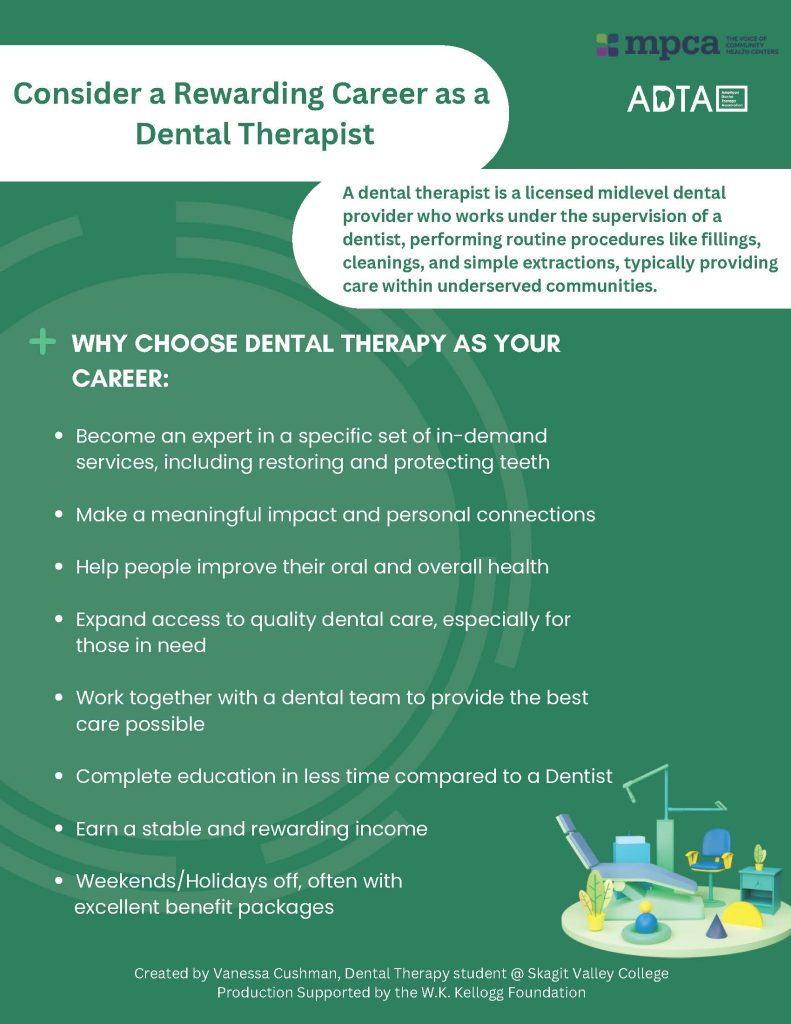
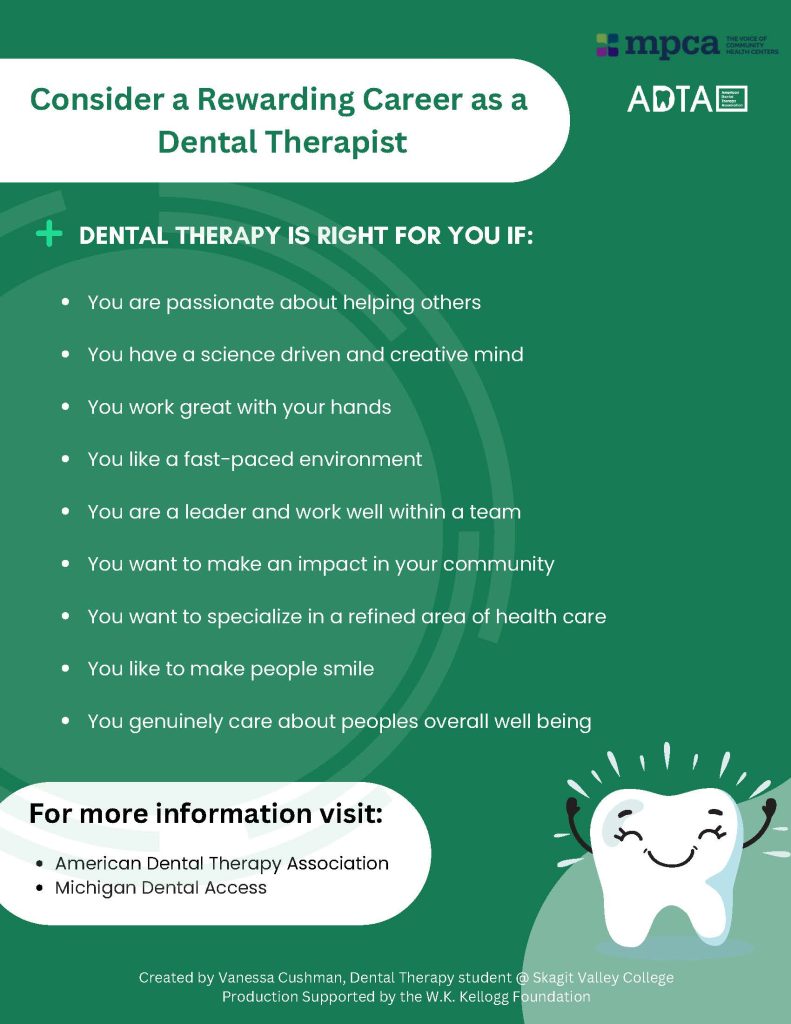
MPCA Dental Therapy Recipient, Vanessa Cushman shares her Journey Towards a Dental Therapy Career

Hello! My name is Vanessa Cushman, and I’m a student in the dental therapy program at Skagit Valley College. I am in year one, and we are wrapping up our second quarter! Most of my days currently are spent with a handpiece in my hand in our simlab or sitting through lectures.

My love for oral health care started when I was young. I enjoyed seeing the entire dental team at my appointments, the kindness and care they showed me did not go unnoticed.  After high school, I joined the dental assisting program at Northwestern Michigan College so I could give back to my community and positively influence younger kids, like how I was influenced.

Upon graduation, I applied at My Community Dental Centers, where I have helped provide care for the past sixteen years, serving those most in need. During this time working in public health, I have been exposed to numerous oral health care crises like early childhood decay, generational trauma, lack of access to care, affordability, and being uninsured. Just in my small hometown of Cadillac, we are severely inundated with patients that need care. Most patients must wait over a year to be seen, which leads to many unnecessary toothaches and emergency extractions. This is heartbreaking to see. As a registered dental assistant, I have restored thousands of teeth and have assisted with extracting thousands more. I laughed with, held hands, cried with, and fought for all my patient’s best interests. I fell in love with providing oral health care to my community but always felt like I could and should do more.

It’s because of this exposure to the oral healthcare crisis that I decided to become a dental therapist. I want to do more, serve more, and make a change in the cycle. I want to be the smiling face they know and can trust, hopefully lessening the fear and trauma associated with visiting the dentist.

By becoming a dental therapist and working under the supervision of a supervising dentist, I will be able to see patients from their initial visit to their final visit, while providing care within my scope of practice. I will be able to treat caries, provide preventive care, emergency care, and even perform some extractions. The idea is that this will greatly lessen the waiting time that patients wait to be seen and cared for, ultimately decreasing the amount of extractions and overall caries.

I am thrilled to become a dental therapist knowing that I will have a positive impact on our community and the needs of our underserved population. I am excited to continue learning here at Skagit Valley and bring back all the knowledge and skills that I am acquiring!

MPCA Dental Therapy Scholarship Recipient, Dana Obey shares takeaways from her Community Rotation

My name is Dana Obey, a Dental Therapy student at Skagit Valley College, where our program director organized a community rotation with the ARCORA Foundation in Longview, Washington. As a Dental Therapist, it’s important to learn a variety of delivery systems accessible to patients, and I’m happy to share my most memorable encounters during the rotation and highlight the importance of teamwork and personalized care in addressing the needs of vulnerable populations. I had the opportunity to work with a diverse patient population, each facing unique barriers to dental care. I’ve learned so much, not only about the technical aspects of dental care but also about the importance of communication, collaboration, and understanding the specific needs of underserved communities. Working with patients who had complex medical histories, socio-economic challenges, and limited access to care reinforced my appreciation for innovative, collaborative approaches to dental treatment.

One of the most impactful experiences during my rotation involved a high-risk geriatric veteran with multiple chronic health conditions, including HIV, high blood pressure, a history of stroke, and prior spinal surgery. These medical challenges made traveling for dental treatment difficult, compounded by long wait times at the local Community Health Center and limited dental services through the Veterans Administration (VA). As a result, the patient had gone without necessary dental treatment for several years.

The Smile Mobile dental bus played a crucial role in providing care. This mobile unit allowed us to deliver services directly to the patient, addressing his immediate dental needs. In collaboration with the supervising dentist,  I adjusted his partial dentures, which had recently become damaged when two anchor teeth fell out. This temporary treatment helped restore some of his chewing function and comfort, allowing him to function until he could access permanent dental care and establish a “dental home.” The patient was extremely grateful for the immediate relief, especially since the care was provided at no cost. We also connected him with a denturist who could assist with future adjustments, and the patient expressed relief knowing he would be able to use his dentures for another year before being eligible for a new set through the VA.

This experience highlighted the critical role of mobile dental care in reaching patients who are unable to travel for care, particularly elderly veterans in rural or underserved areas. The Smile Mobile proved to be a vital bridge to care, and integrating dental therapists into these mobile units can further expand logistical and financial access to dental services for high-risk populations.

Another memorable encounter was with a young man, aged 25-30, who had recently entered a Suboxone treatment program after struggling with drug addiction. He sought dental care for extensive caries on his anterior teeth and expressed a strong desire to “fix things” now that he was in recovery. This patient shared that he had not fully realized the extent of the dental damage caused by his past lifestyle until he had something to smile for again. His renewed commitment to his oral health reflected his broader efforts to improve his overall life.

During our consultation, I learned that the patient was eligible for up to $4,000 in dental treatment assistance through his tribe. To access this benefit, he simply needed to establish a dental home and submit his treatment needs to the tribe. This financial support was crucial in making dental care more accessible and affordable for him, especially after overcoming the significant challenges of addiction. The patient’s excitement about the resources available to him underscored the importance of community-based programs that support individuals in need. It was a powerful reminder that local health organizations and tribal resources can play a pivotal role in improving access to care for underserved populations.

This encounter emphasized the importance of understanding local healthcare resources and the role they play in addressing patients’ needs. It also highlighted the significance of patient empowerment—by being aware of and accessing available resources, patients can make informed decisions about their care and take control of their health. In this case, the patient’s ability to receive financial assistance for dental care was a key factor in helping him move forward in his recovery journey, which reinforced my commitment to advocating for access to care through mobile units and increasing the number of dental providers in underserved communities.

I also worked with patients at a local Wellness Center, particularly focusing on a young recovering addict who required full-mouth rehabilitation due to extensive caries and years of neglect. Throughout his treatment, I noticed his remarkable progress, not only in terms of dental health but also in his personal growth. Despite the challenges many patients at this facility face—such as difficulty with compliance and frequent no-shows—this patient demonstrated remarkable commitment to his treatment plan. Over the course of several appointments, I witnessed a profound cognitive and emotional shift in his attitude, as he eagerly worked to regain his smile. On my last day of rotation, I saw the patient’s joy upon viewing his new smile, thanks to the successful fitting of a removable partial denture. This experience underscored the importance of patience, empathy, and consistency in working with patients who have faced significant life challenges.

Another inspiring figure I encountered during my community rotations was Inga, a Dental Health Aide Therapist (DHAT) for Tulalip. She was deeply committed to keeping children out of general anesthesia by providing dental care in a traditional dental setting. I found it difficult to watch children undergo sedation for treatment due to their high caries risk and need for extensive restorative work. However, Inga’s approach, which focused on behavioral management and more frequent recalls, was particularly inspiring. I observed that children who received this approach were more likely to return for regular check-ups and even looked forward to their “happy visits.” This reinforced my own interest in applying behavioral management techniques and motivational interviewing to prevent the need for sedation and provide care in a less invasive, more positive setting utilizing minimally invasive dental practices.

These various encounters have had a lasting impact on my personal and professional development. They have deepened my understanding of the disparities in access to dental care and the importance of creative solutions to bridge these gaps. From mobile dental units to community-based financial assistance programs and more frequent recall visits, these experiences have reinforced the need for collaboration and a minimally invasive approach to patient care. As I continue to develop as a dental professional, I am committed to advocating for underserved populations and using the knowledge and skills I have gained to improve access to care in my future practice within my tribal community back home in Michigan.

My time working in various dental settings has been an eye-opening and rewarding experience. Through my work with high-risk communities, I have come to appreciate the role of communication, collaboration, and innovative care models in addressing their needs. These experiences have shaped my understanding of the dental profession and reinforced my commitment to promoting equitable access to dental care. Moving forward, I am eager to continue working with underserved communities, advocating for solutions such as dental therapy to aid in improving access to care and ensure that all patients can achieve optimal oral health.

My experiences showcase the need for additional resources to support community-based care such as a mobile dental units for Veterans and families unable to access traditional dental treatment models Mobile dentistry is in my future, and I am eager to be involved in the benefits and impact it can have on communities.

MPCA’s January 2025 Newsletter is out now!

MPCA’s January 2025 Newsletter is here! In this issue we celebrate Social Determinants of Health Month, share UDS reporting resources and highlight upcoming MPCA events and learning opportunities for health center staff. Plus, we share info about our Endorsed Business Partner, Bio-MED Regulated Waste Solutions and shine our Sponsor Spotlight on MPCA Annual Conference Gold Sponsor, UnitedHealthcare Community Plan. Read the full newsletter here.